Wednesday, 28 May 2014

POWERSCOURT GARDENS IN IRELANDVOTED NO.3 IN THE WORLD'S TOP 10 GARDENS

Powerscourt Gardens in Ireland, voted one of the 10 best gardens in the world

It's considered one of the best gardens in the world. And now, National Georgraphic has bestowed upon Powerscourt Gardens in Ireland the No.3 spot on the list of the World's Top 10 Gardens. This award follows several other awards the estate has recently received. These include the Top Ten Houses in the World (Powerscourt House, Lonely Planet), the Best Parkland Venue in Ireland 2014 Award (Powerscourt Golf Club, Golfer’s Guide to Ireland) and the 2014 Certificate of Excellence from Tripadvisor.

Triton Lake, Powersourt Gardens
The magnificent Gardens is just 20 kms south of Dublin and is set against the backdrop of the Sugarloaf Mountain. This 46-acre garden began to take shape almost two-and-a-half centuries ago. It has over 200 varieties of trees, shrubs and flowers set amidst a charming walled garden and majestic terraces; fine statuary and iron works from across Europe dot the landscape, these and the varied trees are linked by carefully designed walks. From the ornate Italian gardens to the Japanese gardens and the more formal Rose Garden and Kitchen Garden there are many hidden treasures to explore. 

The Palladian Mansion surrounded by the beautiful Gardens is now home to the best Irish design and features craft and interior shops. And the Terrace cafe offers the finest home cooked Irish cuisine. 

So, if you happen to be visiting Ireland or have plans to so soon then make sure you enjoy a stroll in the winning Powerscourt Gardens.

Tuesday, 27 May 2014

CALANGUTE BEACH, GOA

Photo: Prashanth Vidyasagar.  At Safil's shack in Calangute beach, Goa. Calungute beach is the largest and the most popular beach in North Goa. This seven-kilometer beach is known as the Queen of beaches. Its seashore is lined with shacks that serve some of the most delicious sea food on this side of the Ocean. 

Sunday, 25 May 2014

SCUBA DIVE 21 FT, ORDER A PIZZA

The round windows in the Lodge are the major attractions. You can have different kinds of fish peering into your bedroom; you can also see the Pizza delivery man swimming up to the door. Photo: Jules Undersea Lodge

Jules Undersea Lodge in Florida, US, began its existence as La Chalupa research laboratory, an underwater habitat used to explore the continental shelf off the coast of Puerto Rico. Located in the Emerald Lagoon, chock-full with reef fish, tropical angel fish, parrot fish, barracuda, snappers, anemones, sponges, oysters and feather duster worms, the lodge is like a sight in the mind of a sci-fi writer.

It sits on legs five feet off the ocean floor. Guests have to Scuba dive 21 feet down into the sea to get to the front door of Jules, which is the first under sea hotel in the US. The air conditioned cottage-sized lodge with a futuristic decor has two private bed rooms and an 8' by 20' common room, which has a well-stocked galley, dining and entertainment areas. Each of the bedrooms and the common room is equipped with telephone, intercom, VCR/DVD etc. 


Entering the Lodge, 21 feet down into the ocean
However, nothing compares to the 42" round window in each room. "Waking up to view a pair of angelfish looking at you through the bedroom window is a sight you'll never forget," states Ian Koblick, owner and co-developer of the Lodge. He and his business partner Neil Monney have over 50 years of combined ocean research and industry experience. The duo named their unique lodge in honour of Jules Verne, author of Twenty Thousand Leagues Under the Sea. "Jules' Undersea Lodge is a tribute to the human quest for exploration and adventure," says Koblick of the lodge which opened its doors to the public in 1986.

The Lodge is filled with compressed air, which prevents water from rising and flooding the rooms. Guests, in scuba gear, enter the lodge via a 5' by 7' 'moon pool' entrance in the floor of the building to reach the wet room, where they leave their diving gear, take a quick hot shower before entering the rest of the living area. You can either enjoy a three-hour vacation ($150 per person) or stay overnight ($675 per person or $800 for a couple). You can have pizza delivered from land or have a chef Scuba dive down to the hotel to prepare and serve a gourmet dinner. 

The Lodge's command centre, manned by a mission director, is land-based and is located at the edge of the Lagoon. The control centre is connected to the undersea lodge by an umbilical cable which delivers fresh air, water, power, and communications. The facility is monitored round the clock. 


You need to dive 21 ft into the water to get to this
To get into Jules' Undersea Lodge, one must be a certified SCUBA diver. If you are not a certified diver, you can take the Discover SCUBA Diving certification for $95. However you cannot take the course if you cannot swim or diabetic or pregnant or have psychological reasons that would prevent you from diving. 


In spite of the many restrictions that would stop most people from diving down to the under sea retreat, the Lodge has had some illustrious guests including former Canadian Prime Minister Pierre Trudeau; rock stars Steve Tyler of Aerosmith and Jon Fishman of Phish.


The Lodge is an impeccable specimen of ingenuity combined with commerce and common sense. It not only provides a unique experience to guests but also protects the lagoon. "Marine life is actually enhanced by the presence of an underwater structure," explains Koblick. The Lodge serves as an artificial reef, providing shelter and substrate for marine animals. And the flow of air to the Lodge constantly adds oxygen to the entire surrounding body of water, creating a symbiotic relationship between technology and nature.

To live beneath the sea was once just the dream of science fiction writers. Now it is a reality... Even for the common man!

For more information log on to: www.jul.com


Saturday, 24 May 2014

AN ZANZIBAR - HOME STAY IN ARTISTS VILLAGE (CHENNAI, TAMILNADU)


You are a couple and looking for a perfect getaway. Or you are a creative person — maybe a writer, a musician, an artist...— who wants some quite to evoke the creative genie in you.Or you are someone who just wants to escape the humdrum of a busy life. Then a regular hotel might not be what you are looking for. 


AN Zanzibar is the homestay that you might want; even what you might 'need'.  And this one is not 'any' home-away-from-home. It is special. 
It is situated inside an artists village. 

You might want to stay here just so that you can tell someone one day — "I once stayed in a place called Zanzibar!" It's cool in that sense too!

Located just 10 minutes walk away from the beach in Chennai, Tamil Nadu (South India) and surrounded by trees, Zanzibar is a private bungalow within Cholamandal Artist Village on ECR. Tastefully decorated with art & antiques, it is the perfect retreat for a short or long quiet break.
Cholamandal is a working artist community and houses a museum of the Madras Movement. AN Zanzibar is located in this artist village.  Mamallapuram, the crocodile park and Dakshin Chithra, the folk art village are all nearby and so are excellent restaurants. And the beach is just 10 minutes walk away.

AN Zanzibar is a 2000sq ft two-bedroom house. AC & hot water available in both rooms.The guests can use the living room, dining deck (and terrace on request) apart from their room. The house has a 'no tv' policy, but there is a fine collection of books and a good music system. 


Shyam is the official host at AN Zanzibar. Apart from settling the guest in, he will also help them to plan their time with regard to places to go to, things to do in the neighbourhood and city. Call taxis, auto rickshaws and buses are readily available. Prepaid taxis are available from the airport and railway stations


TARIFF:

  • Rs.3500 per night for double occupancy and minimum is two night. 
  • Single occupancy is Rs.3200 
  • Breakfast is included.


ADDRESS:
AN ZANZIBAR
29, Cholamandal Artist Village
ECR, Injambakkam, Chennai
Contact: Shyam 089 39 969699

A pictorial walk-through of AN ZANZIBAR


Tuesday, 20 May 2014

MAHABALIPURAM, TAMIL NADU, INDIA

By Suresh Menon. Dawn at Fisherman's Cove, Mahabalipuram, Tamil Nadu, South India. Mahabalipuram is an ancient historic town and once a bustling port. Chariot temples, cave sanctuaries, the Shore Temple with thousands of sculptures dedicated to Lord Shiva — all belonging to the 7th and 8th centuries — can be found here. The group of monuments at Mahabalipuram is a UNESCO World Heritage Site.

Sunday, 18 May 2014

A LUXURY RESORT WITH A CONSCIENCE


Photo: Sabyinyo Silverback Lodge.  One of the cottages at Sabyinyo Silverback Lodge in Rwanda
7000 feet above sea level, on the edge of Parc National des Volcans (where five volcanoes rise up to 15,000 feet) in Rwanda — a country where 800,000 men, women and children were killed in 100 days, and the future, a despondent darkness — sits Sabyinyo Silverback Lodge, a luxury lodge, an emblem of hope; a motif of what a group of people can do to change ordinary lives — for the better.
Sabyinyo Silverback Lodge is built and operated by The Governors' Camp Collection, a 40-year-old company operated by a group of shareholders, and which comprises seven award winning luxury safari camps and lodges in Kenya and Rwanda. It was built in partnership with the African Wildlife Foundation and its partner in Rwanda, the International Gorilla Conservation Program. But right in the beginning, it was decided that the ownership of the lodge would rest with a community trust to be set up specifically to receive rental and other income from the lodge, which would be used to drive socio-economic development and conservation initiatives in the area. A community trust, SACOLA, was established.
View of the volcanoes. Photo: SSL
In May 2006, agreements were signed; in June 2006 construction of the Lodge began; in August 2007 it received its first guest; in September 2007 SACOLA began its mission.
The SACOLA Community Trust projects range from creation of vegetable gardens for a community farming project to reconstruction of a local primary school for 1,600 students to rural electrification project; construction and maintenance of local roads; building of homes for refugees from the genocide and so on. In addition, the Lodge also contributes to the conservation and preservation of the Mountain Gorilla and its fragile habitat and to the wildlife conservation project in Gishwati Forest, 50 km away.
Sabyinyo Silverback Lodge is an illustration of the seamless amalgamation of socio-economic development (of the public and the private), conservation of nature and the collective consciousness working at rebuilding a country, one community at a time.
The rooms are spacious with fire places and a great view of the volcanoes
The Lodge itself can be describe as 'thoughtful' in its design, architecture and the premises on which it operates. The Lodge is only minutes away from the headquarters of the Parc National des Volcans from where one can trek on foot to see the magnificent Mountain Gorilla – perhaps one of the most dramatic, thrilling and poignant wildlife experiences possible. The lodge, situated in the foothills of the mighty Virungas, the chain of 15,000 ft volcanoes stretching through Rwanda, Uganda and the Democratic Republic of Congo, affords wonderful views of the volcanoes and the surrounding countryside.
The Lodge, set in 11 acres of land, comprises five cottages, two suites and one family cottage. They are stone buildings with Rwandanese terracotta tile roofs and feature large sitting areas, fire places, stylish bathrooms finished with Venetian plaster and verandahs with dramatic views of the Virunga Volcanoes and the surrounding lowland farmlands. The close relationship between the Lodge and SACOLA can be explored in the Community Awareness room in the main lodge building, or by visiting the various projects run by SACOLA.
Stylish bathroom finished with Venetian plaster. Photo: SSL
Heat exchangers in the fireplaces provide a plentiful supply of hot water. The family cottage comprises two independent ensuite rooms connected by a shared verandah. The main lodge building comprises reception, sitting room with snug area, dining room, library / games room, a responsible tourism / community awareness room, shop and bathrooms. Three large fireplaces provide warmth and all rooms are finished with a polished wooden floor. Two patio areas afford wonderful and dramatic views to the Virunga Volcanoes and the surrounding lowland farmland.

"Hope is like a road in the country; there was never a road, but when many people walk on it, the road comes into existence," wrote the celebrated Chinese writer Lin Yutang. Sabyinyo Silverback Lodge is 'that' road of hope for some of the communities in Rwanda.

One of the perks of staying at the Sabyinyo Silverback Lodge is that you need to trek just a few
 minutes to see the majestic Mountain Gorilla.  Photo: SSL

For more details check:  www.governorscamp.com or http://on.fb.me/1n9T9y1 


Friday, 16 May 2014

9 Days In Kyoto, Japan

It's called the City of Ten Thousand Shrines. It was once the imperial capital of Japan — for more than a 1000 years. Kyoto (the Japanese say, Kio-to), is in the island of Honshu. The city was built based on traditional Chinese feng shui. Even today, the streets follow a grid pattern. 

Climate: 
Summers are hot and humid and winters are cold with snowfall.
Rains: Mid June - end July
Typhoons: September and October.


Nila Tamaraa chats ups Mathew George (in the pic above), architect, George Design Group (www.gdgindia.com),who recently went to Kyoto.       

When did you go to Kyoto?
I went on May 1 till May 10th, 2014.

Was it a business trip or a holiday?
I was there on a holiday.

Why Kyoto?
Kyoto being the old capital had more history and the outside the main city had amazing works of architecture and landscape by old masters of the trade.

Your first impression of Kyoto 
When you arrive in Kyoto, what strikes you the most is its old world charm that is lacking in Tokyo. You realize there is a lot of history in this place. 

How many days did you stay in Kyoto?
9 days.

Ryokan Tofukuji, a traditional home stay
Where did you stay? 
In Kyoto, I stayed in Ryokan Tofukuji. It was a traditional house managed by a lady named Akemi. The rice paper partition walls opened out to a beautifully laid out Japanese zen garden and the place was located close to Gion and other must- visit locations.


What did you do in Kyoto?


Walk, walk, and walk along Gion, the serene landscaped gardens, the shrines etc. And of course ate a lot of food. Sushi was right on top of that list.

What are the 3 must-visit places in Kyoto?
Denkakuji — for the shrine, the amazing Philosophers Walk and gardens.
Fushima inori — for the mountain climb.
Gion — to experience a page out of Memoirs of a geisha and the night life; and the Nishiki food market and a visit to the world famous aritsegu knife-makers .

Tell us about the food scene in Kyoto  
Kyoto has a rich culinary tradition. The local food culture is diverse and ranges from aristocratic Kaiseki Ryori (it is a traditional multi-course Japanese dinner) to the vegetarian Shojin Ryori (Buddhist cuisine) of monks and the simple Obanzai Ryori (traditional) home style cooking.

What are the 3 must-eat foods in Kyoto? 
Sushi, sushi, sushi. The Pontocho nightlife district is one of the best places to find good fusion restaurants alongside traditional establishments. The Gion district also offers a wide range of interesting dining opportunities, as does the Kyoto Station area.

What are the people like in Kyoto?
Kyoto had been Japan’s capital a long time ago. People here have not forgotten that. They are kinda proud of that; sophisticated and somewhat look down at people from Tokyo or other areas.They are evidently more aloof than the people from Tokyo. But they are nice people.

What sort of place is Kyoto?
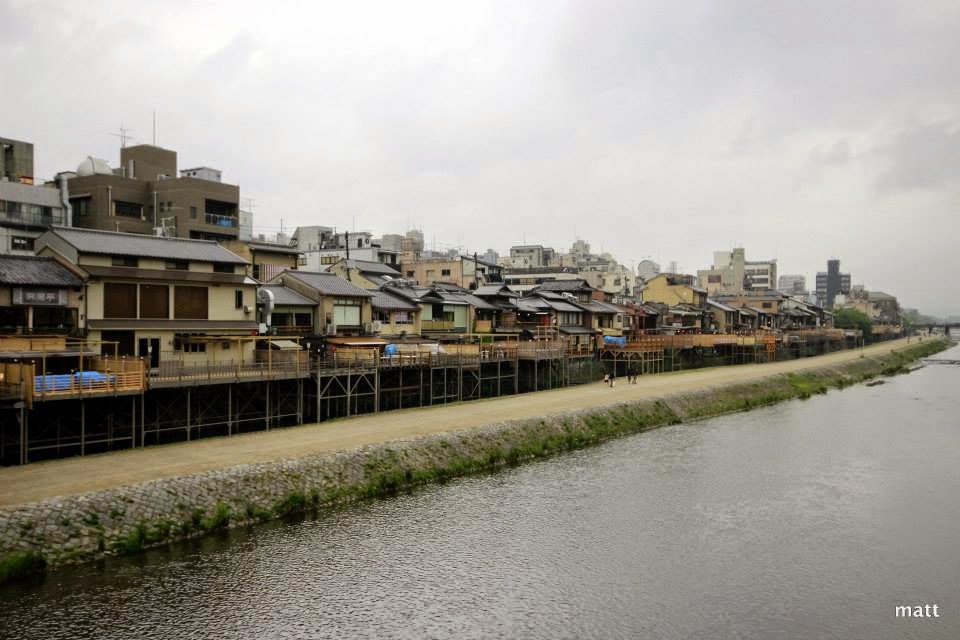
With ancient temples, winding canals lined with cherry and willow trees, and narrow alleys, Kyoto’s past is all around. For a concentrated experience, make your way to Gion, the old geisha district still redolent of the world’s first novel, The Tale of Genji. Here, tiny cobble-stoned lanes are crammed with old wooden structures housing tea rooms, restaurants and small shops specializing in one craft item or another.


Is it a safe place?
It’s very safe. Oh, I also got to experience an earthquake which is a part of life for the Japanese.

What is the one place in Kyoto that you will never forget?
The Kinkakuji (Golden temple and its gardens)

Tell us about the architecture in Kyoto.

Kyoto architecture has traditionally been typified by wooden structures, elevated slightly off the ground, with tiled or thatched roofs. Sliding doors (fusuma) were used in place of walls, allowing the internal configuration of a space to be customized for different occasions. People usually sat on cushions or otherwise on the floor, traditionally; chairs and high tables were not widely used until the 20th century. Since the 19th century, however, Japan has incorporated much of Western, modern and post-modern architecture into construction and design, and is today a leader in architectural design and technology.

How can one travel to Kyoto from Bangalore?
There are many flights to Japan. I personally took the Malaysian airlines as I got an incredible deal on return ticket (Rs 25000)

How many days does one require to spend in Kyoto to enjoy it?
About 5 days

How much money do you need to have a decent holiday in Kyoto — including airfare, boarding and lodging? 
About IRS 100000 for 7 days

Find below some of scenes from Kyoto captured by Matthew George


Kyoto has a glorious past and it is still evident today


Typical Kyoto architecture is traditional wooden structures slightly elevated from the ground


It is a city of shrines and many gardens


Wednesday, 14 May 2014

You like travelling. You also like reading a lot before travelling about travelling. If yes, then you have come to the right place.

Here you will find a list of all-things-travel related websites that can give you useful information or even just let you indulge in a bit of arm-chair travelling with a smile on your face. Here goes:

GO GIRLFRIEND

GoGirlfriend  is an online community of women sharing travel info. It is founded by Julia Rosein from Canada. It is a niche blog that focuses exclusively on travel for women, products and tips. 


A website that should be bookmarked without fail by all solo travellers — both virgin and pro.

It was founded by Lisa Imogen Eldridge — freelance journalist and travel blogger. Her website says that she has been travelling extensively since the age of 21. She still looks roundabout that age, but her 'extensive' blog is testimony to the 'extensive' travel. The blog is a complete guide for any solo traveller — it helps you pre-plan trips and gives you valuable tips.

Tuesday, 13 May 2014

PICTURE TUESDAY — 13 MAY (MALIGNE LAKE, CANADA)


Maligne Lake Chalet, Jasper, Canada. This is a historical national building. Built in 1927, the Chalet is on the banks of the Maligne Lake. It was part of a back-country lodge and it was once one of the largest and most luxurious accomodation in Jasper National Park. There is a main chalet, a Guest House, The Cache, the Wash house — all log buildings. And the evening tea here is a must-have-experience.

Sunday, 11 May 2014

VISUAL TOUR OF BHUTAN


The smallest country in the world is called Drukyul — the Land of the Thunder Dragon. Bhutan, landlocked between India and China, is showing the world — size does not matter. What matters is the 'matter' inside that 'size'. Here is an example: Bhutan's erudite and astute King declared the development philosophy of his nation to be measured under Gross National Happiness. And the rest of the world, which measures its development (and happiness) based on how much money they have in the treasury at the end of the year, went agog! 

Here's another one: This land of rugged mountains and deep valleys has a rich and diverse ecosystem. And the government wishes to keep it that way. So the law of the land states that Bhutan shall maintain at least 60% of its forest cover at all time. Today, approximately 72% of the total land area of Bhutan is under forest cover and this small country boasts of 10 national parks. 


Some stats before Sunjin Balakumaran takes you on a visual-trip through Bhutan


HOW TO GET THERE:
From Thailand – Bangkok; 
Nepal – Kathmandu; Singapore and India - Delhi, Kolkata, Bodh Gaya Dacca, Guwahati.
Drukair, the national airline, is the only airline to operate flights in and out of the country.
There are three land border crossings along the Indian border only - Phuentsholing, Gelephu and Samdrup Jongkhar.
All travel arrangements to Bhutan must be made through a licensed Bhutanese tour operator.
A list of tour companies operating in Bhutan is available here: http://www.tourism.gov.bt/
People from India, Bangaladesh and Maldives can obtain a visa on entry (no cost). All other international tourists need a visa to enter Bhutan. 
CURRENCY: Ngultrum. Its value is tied to the Indian Rupee which is also accepted as legal tender. However Indian notes in 500 and 1000 denominations are not acceptable.
CLIMATE:
Spring: Early March to mid-April Summer: Mid- April to late June (occassional showers). Heavy summer rains: Late June through late September.Autum: Late septemper to late November. Winter:  Late November to March. Frost throughout the country, snowfall is common. The winter northeast monsoon brings gale-force winds at the highest altitudes through high mountain passes, giving Bhutan its name - Drukyul, Land of the Thunder Dragon.


Sujin Balakumaran, a systems analyst from Abu Dhabi, who is also a passionate photographer with a wanderlust heart went travelling in Bhutan, and has captured a sliver of this beauteous land. Here goes:


Photos and captions: by Sujin Balakumaran


Dzongs like this were built in Bhutan and served as religious and administrative centers since the 17th century. This Dzong is located at the confluence of the Pho Chhu (father) and Mo Chhu (mother) rivers in the Punakha–Wangdue valley. The source of the Mo chu river is in the northern hills of Lighsi and Laya in Bhutan, and in Tibet. The Po Chu River is fed by glaciers in the Lunana region of the Punakha valley. After the confluence of these two rivers, the main river is known as Puna Tsang chu or Sankosh and flows down through Wangdiphodrang, crosses the Bhutan–India border at Kalikhola and eventually meets the Brahmaputra river


The Punakha Dzong, also known as Pungtang Dechen Photrang Dzong (meaning The palace of great happiness or bliss) is the administrative centre of Punakha dzongkhag in Punakha. Constructed in 1637–38,it is the second largest and oldest dzong in Bhutan and one of its most majestic structures


Buddhist Monks at Thimphu Chorten


 Prayer Wheels at Thimphu Chorten


Thimphu Chorten was built in 1974 to honour the 3rd King of Bhutan


Himalayan Valleys are Mystical and Colorful — enroute to Thimphu


Chukka, Bhutan - Phuntsholing — Thimphu Highway


Fruits are grown, plucked and sold locally by villagers. On the Phuntsholing-Thimphu Highway


The Sharchop are an Indo-Mongoloid people who migrated from Assam
or Burma during the past 1000 years. Van Driem (1993) indicates the Sharchop and
 closely related aboriginal Monpa (Menba) are descendants of the plurality ethnicity
of Bhutan and the principal pre-Tibetan (pre-Dzongkha) people of that country.The
Sharchop comprise most of the population of eastern Bhutan. Most Sharchop speak
 Tshangla, a Tibeto-Burman language.Because of their proximity to India, some speak
 Assamese or Hindi.


Monks and nuns are expected to fulfill a variety of roles in the essentially
 predominant  Buddhist community in Bhutan. They are expected to live an
austere life focused on the study of Buddhist doctrine, the practice of
 meditation, and the observance of good moral character.


Bhutanese Art - Masks of Oracle or Deity Faces and Animals. It is the tradition of Bhutanese people to offer a pinch of food, placed on the ground, to the deities and spirits before each meal


A young Bhutanese artist giving the final touches to his work of art — a colourful Buddha

Friday, 9 May 2014

40 BEERS FROM AROUND THE WORLD - TASTED, REVIEWED & BURPED BY AN EXTREME BEER LOVER


He is a carpet salesman who travels all around the globe. His twin passions are food & beer. At the end of a hard working day, he returns to the hotel room only to venture out again in search of adventure — in food & beer. He's drank more amount of beer than a dozen people put together; he has a belly to prove. Over to Vishy Shenoy, an extreme beer lover whose life mission is to taste and burp every beer ever to have been brewed on this planet. (This is just the beginning — part I)


Yuengling-lager from Pennsylvania.....smooth! —
 at Fire & Oak Jersey City.

Didnt realise this sick beer beats Bud light as the worlds largest
 selling beer in the world according to wikipedia.
 Things people drink!

Death by Hop!! — at Davidson College.

Tusker- Kenyan Lager...... Nice note to it!! — at Times Square, New York

Redhook Gamechanger Ale is a American Pale Ale
 (APA) style  craft beer brewed by Redhook Ale Brewery,
Woodinville, Washington.At Buffalo Wild Win

The can version - Tsingtao

Harbin - from China's oldest brewery... to me , a step
 lower than Tsingtao

Singtao draft, better than the regular Tsingtao

Brewed in New York! — at Fire & Oak Jersey City.

Konig pilsner, from Beeck area of Duisburg city in the western
part of Germany. Sorry for the low quality of pictures. My battery drained
out before the beer did 

Found out something new! That beers can be mixed
 with  soft drinks to create something unique.  This one
 is the Kolsch cola , also called drecksack in Germany. 
The taste though wasn't worth a repeat

Strong

They couldn't make the beer any more crappier. So they
 let it be.  And now they can compete with Heineken and
carlsberg for the shitty beers of the world!

Warsteiner beer is brewed in the Arnsberg Forest
 Nature Park outside of Warstein, Germany.  Warsteiner is
 Germany's argest  privately owned brewery; its most
 popular  beer is 'Warsteiner Premium Verum', a pilsener 
style beer. The ingredients are forest  spring,water, two-row
 malted summer barley and all German hops.
 4.8 % alcohol content.

Handcrafted beer. I need to be in Australia for
 6 months, just tasting beer!

New additions to the Belgian beers

More Belgian beer

...and some more Belgian beer

...another one - Belgian beer that is

From Bayern, Munich -the dark version

From Hannover

Australian beer

Australian again

Aussies drink this

4 wives Pilsener.... As if one isn't sufficient for a beer!

Italian beer,but I think the Italians should stick to core
 competency of Grappa and not get
into this space

Bintang counts among the good south east
Asian beers!

Cricket without Victoria Bitter  is not just cricket!

hangs from Thailand, doesnt match upto Singha

 Chancer golden ale.


50 Lashes. 

4.9% lager beer. 100% crap from fosters! Stale pineapple
 juice tastes better.
 Australian for beer......my left foot!

5% alcohol

Tastes great

Japanese first flush beer!

 Argentinian beer - nothing great, just normal